Slow Down to Speed Up: The Professional’s Paradox
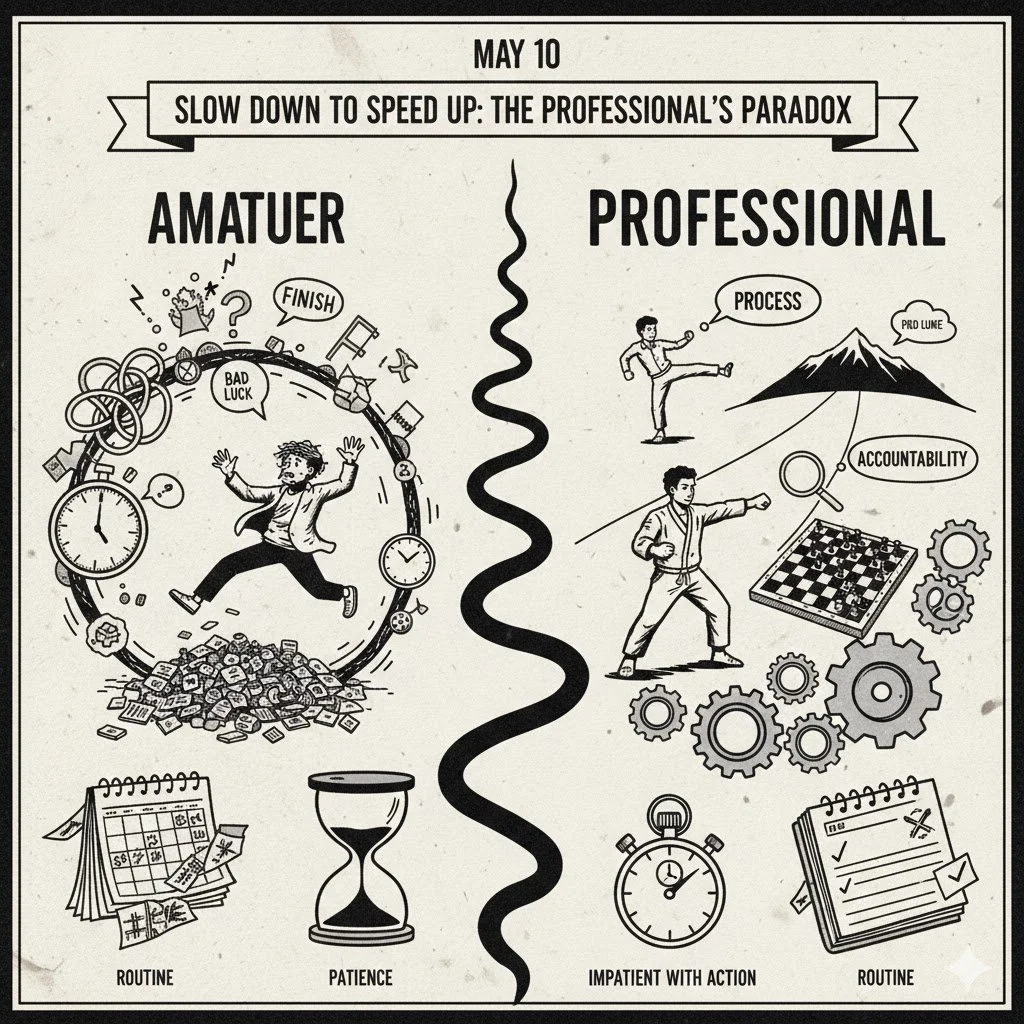
Somewhere in my nerdy journey through systems and processes I came along the idea of the difference between amateurs and professionals.
It’s fascinating to see the lengths (some would say obsessions) top performers will go to in order to be the best at what they do.
Being a professional has nothing to do with a title on a business card—it’s about the processes, habits, systems, and mindsets we bring to our work every single day.
In real estate, just like in any industry, the distinction between amateur and professional is clear. Professionals show up consistently, commit to mastery, and take full ownership of their craft. Amateurs dabble. Professionals deliver.
If we want to level up in our work, we need to understand what sets true professionals apart. Adopting their mindset doesn’t just improve performance—it accelerates our trajectory, creates more “luck,”and unlocks new opportunities we wouldn’t otherwise see.
One of my favorite authors, Sahil Bloom, wrote a great piece on the 11 key differences between amateurs and professionals that perfectly capture this idea. If you’re serious about leveling up your business growth, your mindset, and your success it’s worth some meditation.
What are the differences between professionals and amateurs you’ve observed?
1. Amateurs let the day come to them, Professionals have a routineThe greatest performers in any craft share one trait in common: They have a routine—and they stick to it with intense discipline.
Most of what we call greatness is simply the result of tiny daily actions done well—over and over and over again.
Professionals establish a routine and use it to own each day. They eliminate questions and surprises by controlling the narrative.
Professionals also realize that a routine is useless if the environment is unsuited to following it. Professionals create their environment, they don't just exist in it.
They dictate the terms.
2. Amateurs love the prize, Professionals love the process
You’ll never make it if the view at the summit is the only thing motivating you to keep climbing.
The hunt has to be just as exciting as the meal at the end.
It may sound cliche, but professionals truly fall in love with the process.
3. Amateurs make it look effortful, Professionals make it look effortless
The Paradox of Effort: You have to put in more effort to make something appear effortless.
Professionals recognize that effortless, elegant performances are simply the result of a large volume of gritty, effortful practice.
Small things become big things.
4. Amateurs blame others, Professionals are accountable
In the wake of a failure, there are two types of responses:
The Amateur looks outward—bad luck, unfair circumstances, a cheating opponent.
The Professional looks inward—lack of preparation, gaps in routine, uneven intensity.
Type 1’s stagnate and wither away. Type 2’s grow.
Amateurs attribute success to skill and failure to luck. Professionals recognize the role of skill and luck in every outcome. They focus on the controllable factors. They create an environment where luck is more likely to strike.
Accountability breeds progress.
5. Amateurs are flashy, Professionals are relentless
Many people are able to produce bursts of energy—few are able to produce consistent, steady flows, day in, day out.
The former is flashy, but the latter is relentless.
Professionals take pride in punching the clock—in showing up—every single day.
Never bet against the person who just keeps showing up.
6. Amateurs enter with 100 mediocre moves, Professionals enter with 1 perfect move
"I fear not the man who has practiced 10,000 kicks once, but I fear the man who has practiced one kick 10,000 times." - Bruce Lee
Professionals identify their unique edge—they play *their* game.
The Professional is:
Self-aware to determine their unique edge.
Strategic to set the table to favor that edge.
Ruthless to exploit that edge on the table they set.
They worry less about fixing their weaknesses and more about pressing their strengths.
7. Amateurs fear failure, Professionals embrace itThe Paradox of Failure: The more you fail, the more you ultimately succeed.
Shots on goal are necessary if you want to score. You'll miss 100% of the shots you don't take!
Our greatest moments of growth often stem directly from our greatest failures.
Professionals don't accept failure as inevitable, but they certainly don't fear it either.
Remember: You will fail. Embrace it. Fail smart and fast.
8.Amateurs fear being wrong, Professionals enjoy it
When faced with their own incompetence:
The Amateur flails wildly in an attempt to distract from the obvious gap.
The Professional enlists support to cover the incompetence and repositions the board to avoid its exposure.
Professionals have retrained their minds to embrace new information that forces a change in viewpoint and a strategic improvement.
They view each "software update" as an improvement upon the old.
Remember: Open mindsets rule the world.
9. Amateurs are impatient, Professionals are patient
Amateurs are: Patient with actions and impatient with results.
Professionals are: Impatient with actions and patient with results.
Professionals are able to delay gratification—their low time preference allows them to play long-term games more effectively—but they simultaneously embrace that long-term games are won through tiny daily actions.
10. Amateurs hope for good breaks, Professionals create themAmateurs enter the arena with their fingers crossed.
Professionals enter the arena with a plan. They realize that some of what we call luck is the macro result of thousands of micro actions.
Professionals create more luck.
11. Amateurs press, Professionals wait
When pressure and stress levels elevate:
The Amateur is uncomfortable—they press in an effort to fast-forward to the finish.
The Professional is comfortable—they observe their opponent and wait for the opportune moment to strike.
The Amateur always leaps into motion, believing that forward motion is progress.
The Professional moves slowly—pauses, thinks, and acts.
The Paradox of Speed: Slow down to speed up. Slow is smooth and smooth is fast.
-Alan